


When Police Search the Wrong Apartment in the Bronx: Your Legal Options
When Your Door Wasn’t the One on the Warrant
Most people don’t expect police to ever enter their home, let alone enter it by mistake. In the Bronx, wrong-apartment searches often happen fast and without warning. A loud knock or sudden crash. Officers rushing inside. Commands shouted before you’ve even processed what’s happening. Then, somewhere in the middle of the chaos, it becomes clear. They were never supposed to be there.
At Horn Wright, LLP, our Bronx civil rights attorneys hear from residents who describe this moment as surreal. Some are told right away that police have the wrong place. Others realize it only after officers start asking questions that don’t make sense or comparing addresses. Even when police leave quickly, the damage is done. The sense of safety inside your own home is shaken, and it’s hard to understand how something so serious could be brushed off as a mistake.
How Wrong-Apartment Searches Actually Happen
In theory, warrants are precise. In real life, especially in Bronx apartment buildings, things are messier. Buildings may have poor lighting, confusing layouts, or altered numbering. Multiple apartments may share similar doors or entrances. These conditions increase the risk of error, but they don’t remove police responsibility.
Officers are expected to confirm they are at the correct location before entering. That means checking apartment numbers, verifying descriptions, and slowing down enough to be sure. When police rely on assumptions or rush the process, innocent residents pay the price.
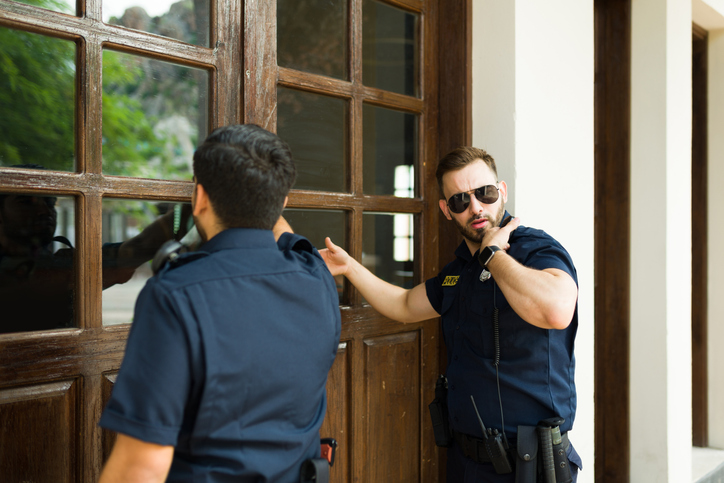
Why the Search Warrant Itself Matters So Much
A valid search warrant must clearly identify the exact place police are authorized to search. In an apartment building, that specificity is critical. The warrant should leave no doubt about which unit is the target.
If the warrant is vague, inaccurate, or outdated, the risk of a wrong-apartment search increases. A warrant for “Apartment 3B” does not authorize entry into “Apartment 3A,” even if officers believe they’re close enough. Probable cause for one residence does not spill over into another.
Warrants are issued under standards enforced by the New York State Unified Court System, which requires judges to act as a check on police authority. When a warrant fails to clearly describe the correct location, that safeguard breaks down.
How Knock-and-Announce Could Have Stopped the Search
Knock and announce isn’t just about courtesy. It’s a built-in pause that can prevent devastating mistakes. When police knock, identify themselves, and state their purpose, occupants have a chance to respond. That response often reveals that officers are at the wrong address.
In many wrong-apartment cases, police skipped knock and announce. Doors were forced open without warning, leaving no opportunity for anyone inside to say, “You have the wrong place.” When officers choose speed over verification, the likelihood of error rises sharply.
If police claim they skipped knocking due to urgency or danger, courts look closely at whether that decision was justified or simply convenient.
When Protective Sweeps Make Things Worse
Once inside the wrong apartment, police often conduct a protective sweep. These sweeps are meant to be quick safety checks for other people who could pose a threat. They are not searches for evidence.
In practice, protective sweeps in wrong-apartment cases often expand beyond their purpose. Officers move through bedrooms, open closets, and scan personal spaces, even though there was never a lawful reason to be inside the apartment at all. Each additional step deepens the violation.
A protective sweep cannot legitimize an entry that should never have happened. When police realize they are in the wrong apartment, the sweep should stop, not expand.
Why “We Made a Mistake” Isn’t Enough
Residents are often told that the search was an honest error. While mistakes happen, constitutional protections don’t disappear because officers didn’t mean to cause harm. The law focuses on whether police acted reasonably and followed required procedures.
Courts look at:
- Whether the warrant clearly described the apartment
- Whether officers verified the address before entry
- Whether knock and announce was followed
- How quickly police realized the mistake
- What they did after discovering it
Good intentions do not undo a violation, especially when privacy has already been invaded.
The Personal Impact Lingers Long After Police Leave
Being searched by mistake can change how people feel in their own homes. Residents describe anxiety when they hear noises in the hallway, trouble sleeping, and fear that police could return without warning. Children may become scared of authority figures. Property damage can take time and money to repair.
These effects are real, even if no arrest was made and no charges were filed. The law recognizes the home as the most protected space for a reason. When that space is violated, the harm runs deeper than inconvenience.
How Courts View Wrong-Apartment Searches
Courts treat wrong-apartment searches as serious constitutional issues. Judges examine whether police took reasonable steps to avoid invading the wrong home. They also consider whether officers could have slowed down without increasing risk.
Fourth Amendment principles, shaped by decisions from the Supreme Court of the United States, emphasize that the right to be secure in one’s home is fundamental. Entering the wrong residence strikes at the core of that protection.
What to Do Right After a Wrong-Apartment Search
If police searched your apartment by mistake, write everything down as soon as you can. Include the time, how officers entered, whether they knocked, and which rooms they went into. Take photos of any damage.
If officers said anything about the warrant, note those details. Even small observations can matter later. Preserving your account helps ensure that what happened doesn’t get minimized or forgotten.
Understanding Your Legal Options in the Bronx
Wrong-apartment searches may give rise to legal claims, even if police left without making an arrest. The key questions involve how the warrant was written and how officers executed it. These cases are about accountability and preventing repeat violations.
You don’t need to know exactly which rights were violated to ask questions. Uncertainty itself is a reason to seek clarity.
Moving Forward After Police Search the Wrong Apartment
When police search the wrong apartment, the violation is personal and profound. Knowing how warrant requirements, knock-and-announce rules, and protective sweep limits apply can help restore a sense of control.
At Horn Wright, LLP, our Bronx civil rights lawyers help residents understand what went wrong and what steps may be available after an unlawful search. If police entered and searched your Bronx apartment by mistake, call 855-465-4622 to speak with Bronx civil rights attorneys who will take the time to listen and walk through your options.

What Sets Us Apart From The Rest?
Horn Wright, LLP is here to help you get the results you need with a team you can trust.
-
Client-Focused ApproachWe’re a client-centered, results-oriented firm. When you work with us, you can have confidence we’ll put your best interests at the forefront of your case – it’s that simple.
-
Creative & Innovative Solutions
No two cases are the same, and neither are their solutions. Our attorneys provide creative points of view to yield exemplary results.
-
Experienced Attorneys
We have a team of trusted and respected attorneys to ensure your case is matched with the best attorney possible.
-
Driven By Justice
The core of our legal practice is our commitment to obtaining justice for those who have been wronged and need a powerful voice.