


Trucking Regulations That Protect Your Rights
Federal and State Laws Keep Truck Drivers Accountable
Every time a commercial truck pulls onto the highway, it becomes part of a vast and highly regulated system designed to protect everyone on the road. Trucking isn’t just about transportation, it’s about compliance with detailed safety laws that prevent deadly accidents. When trucking companies or drivers ignore those rules, lives are put at risk, and the law gives victims the right to demand justice.
At Horn Wright, LLP, our big rig truck accident attorneys have spent years holding trucking companies accountable under both federal and New York State regulations. These laws aren’t suggestions, they’re obligations. And when they’re violated, injured victims have strong legal grounds to pursue compensation for the harm caused.
From mandatory maintenance schedules to strict limits on driving hours, every rule has one purpose: to keep the roads safe. When those rules are ignored, it’s not an accident, it’s negligence.
Key Safety Regulations That Apply to New York Trucking Companies
Trucking in New York is governed by both federal regulations from the Federal Motor Carrier Safety Administration and state-level rules enforced by the New York State Department of Transportation (NYSDOT).
Some of the most important safety requirements include:
- Commercial driver licensing (CDL) standards under 49 C.F.R. Part 383, which ensure drivers are properly trained and certified.
- Regular vehicle inspections and maintenance under 49 C.F.R. Part 396, designed to prevent equipment failures such as brake or tire blowouts.
- Load securement rules under 49 C.F.R. §393.100–136, which require cargo to be tied down and evenly distributed to prevent rollovers.
- Drug and alcohol testing under 49 C.F.R. Part 382, requiring random testing for commercial drivers.
New York mirrors many of these federal standards but adds its own oversight, particularly for intrastate trucking. For example, drivers operating only within the state must also comply with the New York State Transportation Law §140(1), which holds companies liable for failing to maintain safe operations.
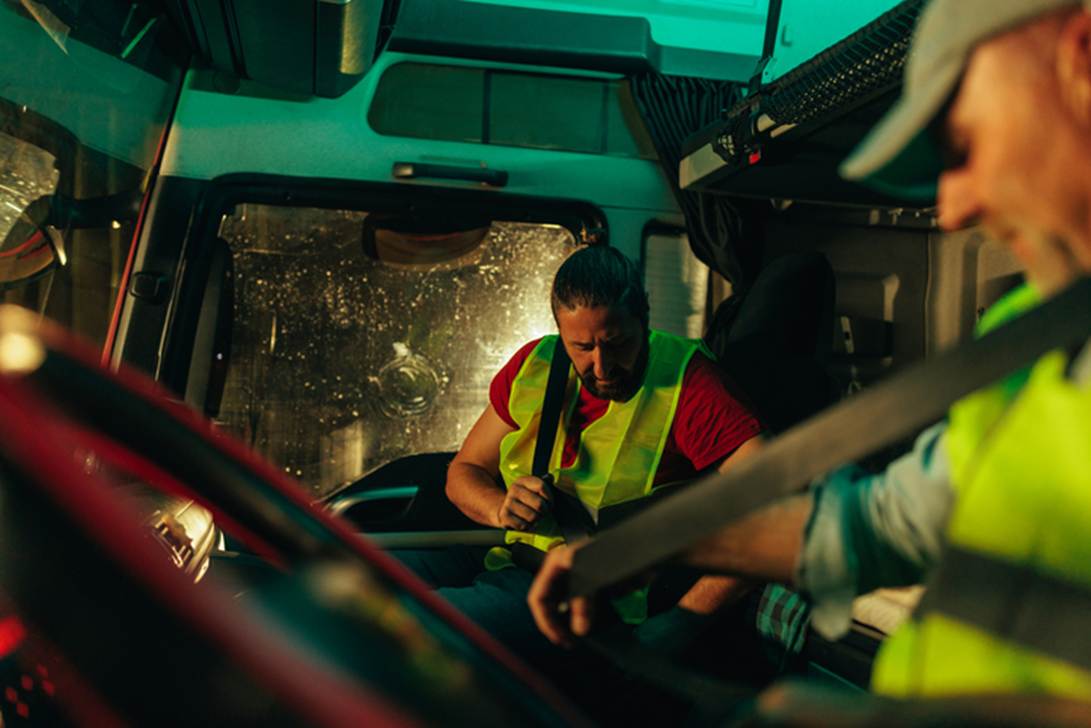
How Hours-of-Service Rules Prevent Driver Fatigue
One of the leading causes of serious truck accidents is driver fatigue. Long-haul truckers often face intense pressure to meet delivery schedules, but pushing beyond safe limits can be deadly. That’s why hours-of-service (HOS) rules exist.
Under 49 C.F.R. Part 395, commercial drivers are limited to:
- 11 hours of driving time after 10 consecutive hours off duty.
- A maximum of 60/70 hours on duty over a 7- or 8-day period.
- Mandatory 30-minute breaks after eight hours of driving.
These rules aren’t arbitrary. They’re based on decades of research showing that fatigue impairs reaction times as severely as alcohol.
Despite these standards, some trucking companies push drivers to falsify logbooks or manipulate electronic logging devices (ELDs). Others turn a blind eye to violations as long as deliveries stay on schedule.
When our firm investigates a crash, we examine driving logs, fuel receipts, and GPS data to uncover whether the driver exceeded legal limits. Fatigue doesn’t leave visible marks, but the evidence always tells the truth, and it can make the difference between a weak claim and a powerful case for full compensation.
When Companies Violate Maintenance and Inspection Laws
Every truck on the road must meet mechanical safety standards before it ever moves a mile. Yet far too often, companies skip maintenance checks or delay necessary repairs to save time and money.
Federal law requires carriers to inspect and maintain every vehicle in their fleet under 49 C.F.R. §396.3. This includes routine brake inspections, tire checks, steering system maintenance, and proper lighting. New York adds further oversight through the Vehicle and Traffic Law §375, which mandates that all commercial vehicles operating within the state remain in “good working order.”
When companies ignore these responsibilities, mechanical failures lead to tragedy, a truck with worn brakes can’t stop in time, and one with defective lights becomes invisible at night.
In truck accident litigation, maintenance records are a goldmine of information. A missing inspection log or repair report often points to negligence at the management level, not just the driver. Horn Wright, LLP, digs deep into these records to hold both the company and its insurer fully accountable.
In Maine, Trucking Oversight Is Less Comprehensive Than in New York
While both states adopt federal trucking laws, Maine’s enforcement structure is less aggressive than New York’s. Maine relies more heavily on voluntary compliance, meaning fewer roadside inspections and a smaller state enforcement division.
In contrast, New York operates one of the country’s most active safety enforcement programs through the Commercial Vehicle Safety Alliance and the State Police Commercial Vehicle Enforcement Unit. This means that in New York, companies face stricter audits, more frequent inspections, and higher penalties for violations.
For victims, that difference matters. New York’s regulatory environment makes it easier to uncover violations that prove fault in court. The records exist, the oversight is consistent, and the law gives injured parties a stronger evidentiary foundation to build from.
How Violations Strengthen Your Injury Claim
Every rule that a trucking company or driver breaks adds weight to a victim’s case. Violations of federal or state regulations often serve as “negligence per se”, meaning the act of breaking the law itself is proof of negligence.
That principle allows victims to focus not just on what happened during the crash, but why it happened, and whether it could have been prevented if the company had followed the law.
For example:
- If a trucker exceeds legal driving hours, fatigue may be presumed to have caused the crash.
- If inspection logs are missing, courts can infer the truck was improperly maintained.
- If the carrier ignored weight limits, it can be directly tied to the vehicle’s loss of control.
At Horn Wright, LLP, we use these violations strategically to build powerful claims. By connecting the dots between regulatory breaches and the harm caused, we turn complex safety data into persuasive, courtroom-ready evidence.
Why Legal Expertise in Trucking Law Matters
Truck accident cases aren’t like ordinary car crashes. They involve multiple layers of law, federal safety regulations, state negligence statutes, and commercial insurance contracts worth millions of dollars.
An attorney without trucking law experience may miss crucial violations buried in maintenance logs or driver records. At Horn Wright, LLP, we know what to look for, and we understand how to use it effectively. Our legal team partners with accident reconstruction experts, mechanics, and former FMCSA investigators to identify every responsible party, from the driver to the dispatch manager.
The trucking industry is heavily regulated for a reason: mistakes at this scale cost lives. Having a lawyer who knows how those rules operate is the difference between a settlement that barely covers medical bills and one that truly accounts for the pain, lost income, and long-term care you deserve.
Horn Wright, LLP, Enforces the Laws That Protect Truck Accident Victims
When a trucking company ignores the laws meant to keep people safe, the consequences ripple far beyond the crash scene. Victims face long recoveries, financial strain, and the weight of a system that too often protects corporations over people.
At Horn Wright, LLP, our personal injury attorneys take those laws, the federal codes, the state statutes, the industry rules, and use them to fight back. We understand how to prove violations, expose negligence, and secure justice for those who’ve been harmed.
Call our offices today to get started.

What Sets Us Apart From The Rest?
Horn Wright, LLP is here to help you get the results you need with a team you can trust.
-
Client-Focused ApproachWe’re a client-centered, results-oriented firm. When you work with us, you can have confidence we’ll put your best interests at the forefront of your case – it’s that simple.
-
Creative & Innovative Solutions
No two cases are the same, and neither are their solutions. Our attorneys provide creative points of view to yield exemplary results.
-
Experienced Attorneys
We have a team of trusted and respected attorneys to ensure your case is matched with the best attorney possible.
-
Driven By Justice
The core of our legal practice is our commitment to obtaining justice for those who have been wronged and need a powerful voice.