

Manhattan Distracted Driving Crashes: Texts, GPS, and Apps
Distracted Driving and Liability in NYC
Driving in Manhattan demands full attention. Every block brings a new challenge: sudden lane closures, aggressive merges, honking horns, unpredictable cyclists, and pedestrians rushing the crosswalk.
You can’t afford to look away, even for a moment. But many drivers do. They check a text, glance at a GPS, scroll a playlist, and then crash. That causes serious injury in seconds.
At Horn Wright, LLP, we’ve helped many New Yorkers recover after crashes caused by distracted drivers. Our Manhattan car accident attorneys know the tactics insurance companies use to avoid blame and how to gather the evidence that proves negligence.
If you’ve been hurt because someone couldn’t put the phone down, we’re ready to step in and advocate for what you’re owed.
What New York Law Says About Distracted Driving
New York’s distracted driving laws are strict, and for good reason. Section 1225-d of the New York Vehicle & Traffic Law makes it illegal for drivers to use any portable electronic device while operating a motor vehicle.
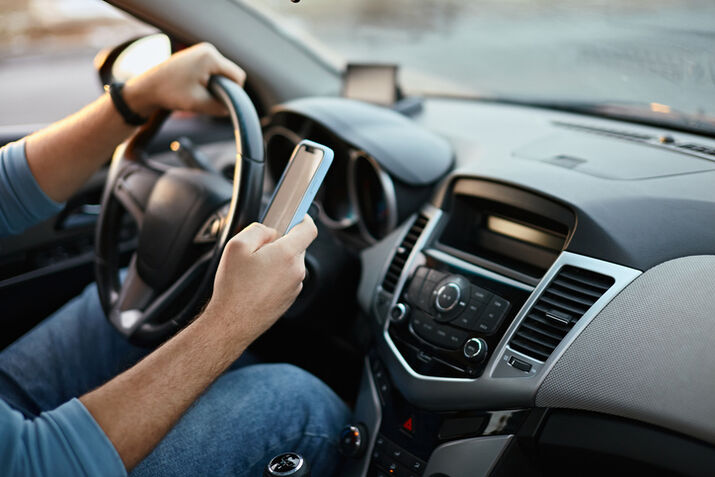
This doesn’t just mean texting. The law includes holding a phone, checking apps, using email, browsing the internet, or navigating maps without a mounted device.
Drivers often misunderstand what’s legal. Holding a phone at a red light? Illegal. Reading a text while in stop-and-go traffic on the West Side Highway? Still a violation. The law doesn’t require a driver to send a message. Simply viewing content can count as distracted driving. And if that moment of distraction leads to a crash, civil liability quickly follows.
Even hands-free devices don’t guarantee safety. They may be legal, but they still pull a driver’s focus away from the road. The result: slower reaction times, missed signals, and poor situational awareness.
How Phones, Apps, and Alerts Disrupt Safe Driving
Multitasking behind the wheel always carries risk, but mobile apps raise that risk dramatically. Drivers don’t just talk anymore. They text, stream, swipe, and share.
While navigating heavy traffic through Midtown or Chelsea, even a five-second glance at a phone can mean the difference between stopping in time or rear-ending another car.
Texting combines three distractions at once: visual, manual, and cognitive. A driver looks away, takes a hand off the wheel, and stops focusing on traffic. The same goes for messaging apps, music platforms, and social media notifications.
Location-sharing apps can be just as bad. A ping from a delivery update may prompt a driver to check the screen while rolling past a busy crosswalk.
In our work, we’ve seen distraction lead to:
- Rear-end collisions at red lights when a driver doesn’t notice traffic has stopped. These usually occur at low speeds but can still result in neck and back injuries.
- Intersection crashes because a driver runs a light while reading a message. Timing errors caused by distraction often lead to side-impact collisions.
- Swerve-and-side collisions caused by inattention while changing lanes. These are especially dangerous on Manhattan’s narrow one-way streets.
In every one of those scenarios, the phone divides attention.
GPS Confusion on Urban Roads
Manhattan’s street grid looks simple, but navigation still confuses many drivers.
GPS apps try to help, but they often create distraction instead. When a driver tries to catch a last-second left turn off 10th Avenue or fumbles with rerouting near the Queens-Midtown Tunnel, accidents happen.
The problem isn’t GPS alone. It’s when drivers fixate on the device instead of the road. Looking down to confirm an upcoming turn or tapping to change the route draws attention away from nearby hazards. Delayed reactions and missed signs are common.
GPS-related distraction often leads to hesitating in intersections, braking without warning, improper merges, or missed crosswalks during turns. And when GPS reroutes in response to traffic or closures, drivers trying to reorient themselves can block lanes or cause unexpected stops.
In a fast-paced environment like Manhattan, those small disruptions cause big consequences.
Crash Patterns Linked to Distracted Driving
Certain types of collisions appear more often in distraction-related crashes. In Manhattan, they frequently occur in areas with heavy congestion, mixed traffic modes, and stop-and-go flow.
The most common patterns include rear-end collisions on avenues like Broadway or Amsterdam when drivers don’t see stopped traffic, and T-bone crashes at intersections when a distracted driver runs a red light or misses a yield.
Pedestrian strikes are also frequent in zones like Times Square or the Lower East Side where visibility is key. Sideswipes from veering into adjacent lanes often happen during lane shifts or merges.
Distraction doesn’t just cause drivers to miss signals. It also causes them to drift out of position, fail to respond to sudden slowdowns, or completely overlook foot traffic and bike lanes.
Proving Distraction After a Manhattan Crash
Proving that a driver was distracted can be difficult without the right tools and timing. But with immediate action and the right legal support, it becomes possible to show what happened and why.
Phone records can show texts or calls at the time of the crash. These records often serve as crucial evidence in personal injury claims. Witnesses, especially pedestrians or passengers, may have seen a driver holding or using a device.
Firsthand accounts provide real-time insight that cameras may miss. Dashcam footage or surveillance video from businesses in SoHo, Harlem, and the Financial District often supports claims.
These videos can establish the sequence of events leading to a collision. In some crashes, lack of braking evidence or erratic steering patterns can also indicate distraction. Accident reconstruction experts often look at this data to determine cause.
For serious collisions, attorneys may even seek forensic analysis of phone data. The faster this evidence is preserved, the stronger your case becomes. Once cars are cleared and phones are locked, the chance to document what really happened gets much smaller.
Shared Fault Still Allows Recovery
New York follows a pure comparative negligence system.
That means even if you’re partially responsible for a crash, you can still recover damages. So if a distracted driver hit you, but you were also changing lanes without signaling, you may still receive compensation—reduced by your share of the fault.
For example, let’s say a distracted driver rear-ends you near the entrance to the FDR Drive, but your taillights weren’t functioning properly. If investigators assign you 20% of the fault, you can still recover 80% of your damages.
This matters because insurers sometimes try to deflect blame entirely. They may argue you braked too hard or stopped suddenly. That’s why understanding your percentage of fault, and how to challenge an unfair assignment, is critical in distracted driving claims.
What to Do After a Distracted Driving Crash in Manhattan
Right after a crash, things move fast and decisions matter. If you believe distraction played a role, document everything as quickly as possible.
Here’s what we recommend:
- Call 911 and make sure police respond to create an official crash report. This ensures that your version of events is documented by law enforcement.
- Photograph the scene, including phone placement, traffic signs, skid marks, and street names. These images help support your version of events.
- Speak with witnesses, especially pedestrians or rideshare passengers who may have seen the other driver on their phone. Their statements can add credibility to your claim.
- Request business camera footage if the crash happened near storefronts in Midtown, Chinatown, or Harlem. Surveillance often provides unbiased proof.
- Seek medical care even if you feel fine. Many injuries develop hours after impact. Early medical records strengthen injury claims.
- Report the crash to your insurance company, but avoid guessing about what happened. Stick to facts. Avoid making assumptions that could affect your claim.
These steps help preserve the details that prove distraction, protect your health, and establish your right to seek compensation.
Focus Saves Lives. Negligence Costs Them
Distracted driving causes real harm on Manhattan streets.
Every alert, every glance, every second spent staring at a screen instead of the road increases the risk of injury. If you’ve been injured because another driver made that choice, you don’t have to carry the burden alone.
At Horn Wright, LLP, we help clients stand up to insurance companies and demand accountability. Our Manhattan car accident attorneys know what it takes to prove distraction and fight for the full compensation you deserve.
If you're ready to move forward, we’re ready to stand with you.

What Sets Us Apart From The Rest?
Horn Wright, LLP is here to help you get the results you need with a team you can trust.
-
Client-Focused ApproachWe’re a client-centered, results-oriented firm. When you work with us, you can have confidence we’ll put your best interests at the forefront of your case – it’s that simple.
-
Creative & Innovative Solutions
No two cases are the same, and neither are their solutions. Our attorneys provide creative points of view to yield exemplary results.
-
Experienced Attorneys
We have a team of trusted and respected attorneys to ensure your case is matched with the best attorney possible.
-
Driven By Justice
The core of our legal practice is our commitment to obtaining justice for those who have been wronged and need a powerful voice.